37 Inference for Adjusted Comparisons
$$ \newcommand{X}{} \newcommand{Y}{}
$$
Introduction
Where We Are
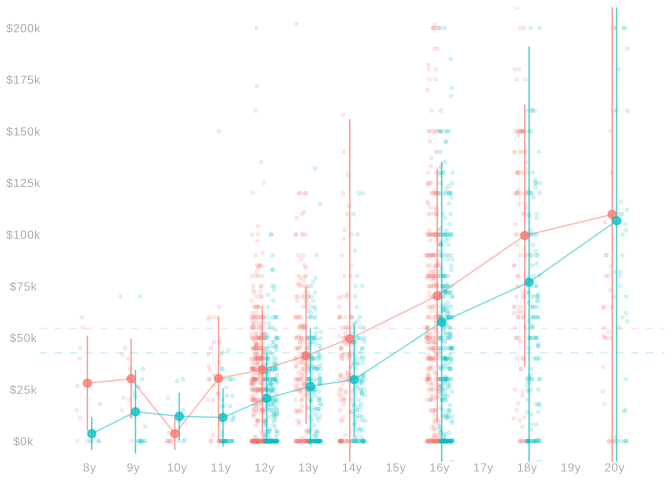
Last time we saw that “the income gap” isn’t one number. We computed several adjusted comparisons.
| Estimator | Value | Averages Over |
|---|---|---|
| \(\hat\Delta_{\text{raw}}\) | -12k | Nothing (raw means) |
| \(\hat\Delta_1\) | -15k | Women’s education distribution |
| \(\hat\Delta_0\) | -15k | Men’s education distribution |
| \(\hat\Delta_{\text{all}}\) | -15k | Everyone’s education distribution |
Today we’ll ask: how do we do inference for these estimators? How precise are they? And why are some harder to estimate than others?
The Setup
All of these estimators are linear combinations of within-group means \(\hat\mu(w,x)\). For example, the raw comparison is \[ \hat\Delta_{\text{raw}} = \bar Y_1 - \bar Y_0 = \sum_x P_{1,x} \hat\mu(1,x) - \sum_x P_{0,x} \hat\mu(0,x) \] where \(P_{w,x} = N_{w,x} / N_w\) is the proportion of group \(w\) at education level \(x\).
The adjusted comparisons have the same structure. \[ \hat\Delta_1 = \sum_x P_{1,x} \qty{\hat\mu(1,x) - \hat\mu(0,x)} \]
We can write all of them as \[ \hat\theta = \sum_{w,x} \hat\alpha(w,x) \hat\mu(w,x) \] for some coefficients \(\hat\alpha(w,x)\) that may be random (depending on sample proportions) or fixed.
Unbiasedness
The Question
When is \(\hat\theta = \sum_{w,x} \hat\alpha(w,x) \hat\mu(w,x)\) an unbiased estimator of \(\theta = \sum_{w,x} \alpha(w,x) \mu(w,x)\)?
The answer comes from two facts we already know.
- Within-group sample means are unbiased for within-group population means: \(\mathop{\mathrm{E}}[\hat\mu(w,x) \mid N_{w,x}] = \mu(w,x)\).
- Sample proportions are unbiased for population proportions: \(\mathop{\mathrm{E}}[P_{w,x}] = p_{w,x}\).
The Calculation
Using the law of iterated expectations, \[ \begin{aligned} \mathop{\mathrm{E}}\qty[\sum_{w,x} \hat\alpha(w,x) \hat\mu(w,x)] &= \sum_{w,x} \mathop{\mathrm{E}}\qty{\hat\alpha(w,x) \mathop{\mathrm{E}}[\hat\mu(w,x) \mid X_1 \ldots X_n]} \\ &= \sum_{w,x} \mathop{\mathrm{E}}\qty{\hat\alpha(w,x)} \mu(w,x) \end{aligned} \]
So our estimator is unbiased if \(\mathop{\mathrm{E}}[\hat\alpha(w,x)] = \alpha(w,x)\) for all \(w,x\).
For \(\hat\Delta_1\), the coefficients are \(\hat\alpha(1,x) = P_{1,x}\) and \(\hat\alpha(0,x) = -P_{1,x}\). Sample proportions are unbiased, so \(\hat\Delta_1\) is unbiased.
The same argument works for \(\hat\Delta_0\), \(\hat\Delta_{\text{all}}\), and \(\hat\Delta_{\text{raw}}\).
Variance
Why It Matters
Unbiasedness tells us our estimator is centered at the right place. But how spread out is it? That determines the width of our confidence intervals.
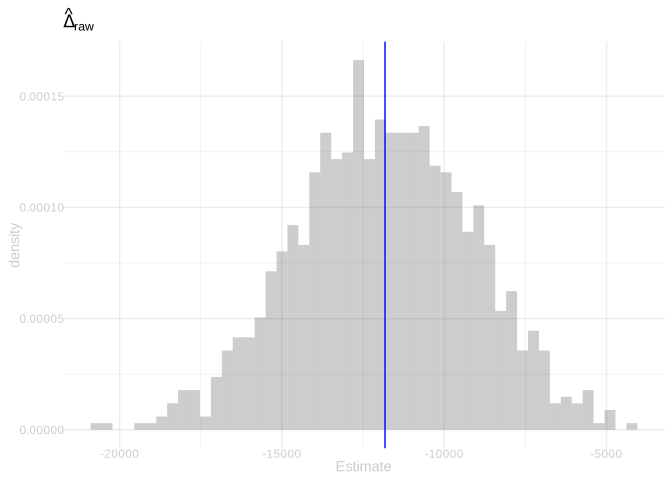
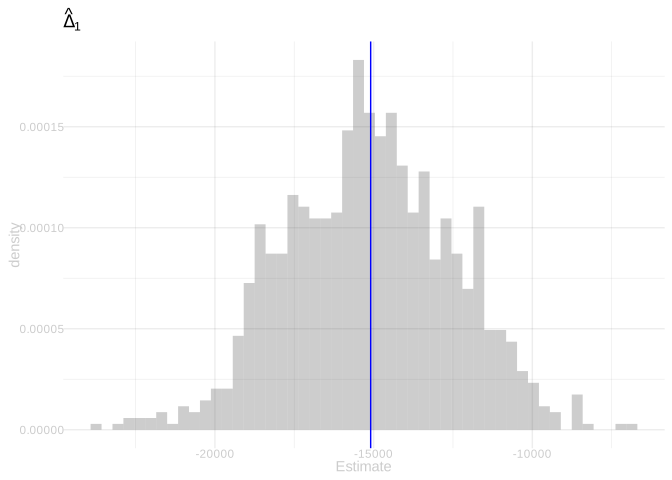
The bootstrap shows that \(\hat\Delta_1\) has a wider sampling distribution than \(\hat\Delta_{\text{raw}}\). Why?
A Variance Formula
For estimators of the form \(\hat\theta = \sum_{w,x} \hat\alpha(w,x) \hat\mu(w,x)\), the variance has two parts.
\[ \mathop{\mathrm{\mathop{\mathrm{V}}}}[\hat\theta] = \underbrace{\sum_{w,x} \sigma^2(w,x) \mathop{\mathrm{E}}\qty[\frac{\hat\alpha(w,x)^2}{N_{w,x}}]}_{\text{variance from estimating } \mu(w,x)} + \underbrace{\mathop{\mathrm{\mathop{\mathrm{V}}}}\qty[\sum_{w,x} \hat\alpha(w,x) \mu(w,x)]}_{\text{variance from random coefficients}} \]
The first term captures the uncertainty in estimating each within-group mean. The second captures the uncertainty from using random weights (sample proportions).
When the coefficients are fixed (not random), the second term is zero. When they’re random, it’s usually small compared to the first term.
The Key Insight
The first term is what matters most. \[ \mathop{\mathrm{\mathop{\mathrm{V}}}}[\hat\theta] \approx \sum_{w,x} \sigma^2(w,x) \frac{\hat\alpha(w,x)^2}{N_{w,x}} \]
This tells us something important: an estimator is hard to estimate precisely when it puts large weight on small subgroups.
If \(\hat\alpha(w,x)\) is large but \(N_{w,x}\) is small, that term contributes a lot to the variance.
Comparing Estimators
Let’s see how this plays out for our estimators.
For \(\hat\Delta_{\text{raw}}\), the variance is roughly \[ \mathop{\mathrm{\mathop{\mathrm{V}}}}[\hat\Delta_{\text{raw}}] \approx \frac{\sigma^2_1}{N_1} + \frac{\sigma^2_0}{N_0} \] where \(\sigma^2_w\) is the variance of income within group \(w\). This is the familiar two-sample formula.
For \(\hat\Delta_1\), the variance involves the within-education-level variances. \[ \mathop{\mathrm{\mathop{\mathrm{V}}}}[\hat\Delta_1] \approx \sum_x P_{1,x}^2 \qty{\frac{\sigma^2(1,x)}{N_{1,x}} + \frac{\sigma^2(0,x)}{N_{0,x}}} \]
The problem: if women (group 1) have many people at education level \(x\), then \(P_{1,x}\) is large. But if men have few people at that education level, \(N_{0,x}\) is small. The ratio \(P_{1,x}^2 / N_{0,x}\) can be large.
Covariate Shift Hurts Precision
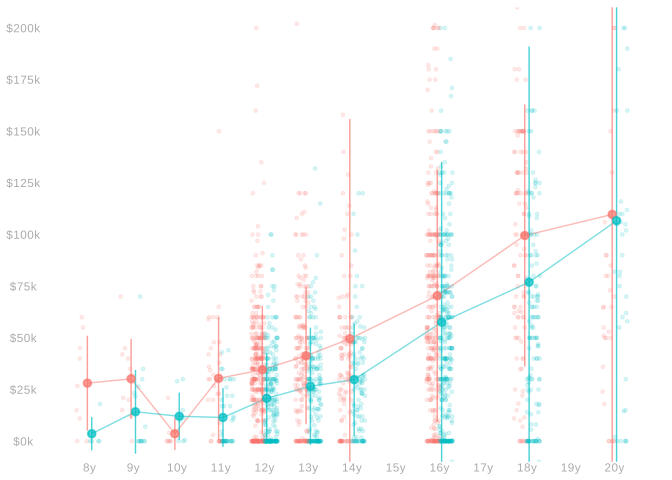
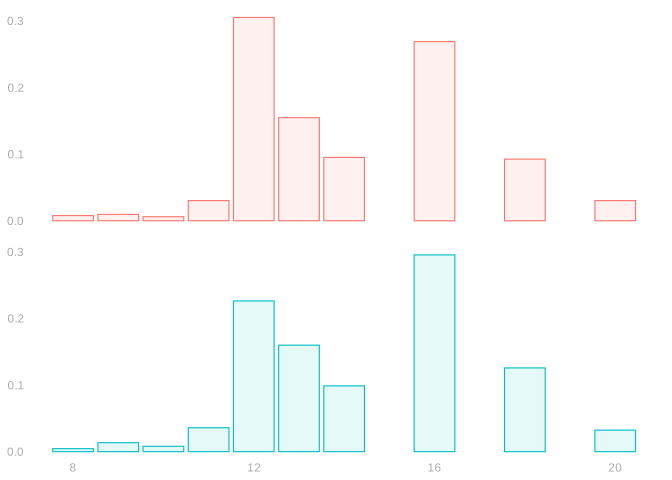
When the two groups have different covariate distributions (covariate shift), the adjusted estimators become harder to estimate. You’re asking: what would women earn if they had men’s education? But there aren’t many men at the education levels where most women are.
This is the price of adjustment. You get a more meaningful comparison, but a noisier estimate.
Variance Estimation
We can estimate the variance using the same formula with sample quantities. \[ \widehat{\mathop{\mathrm{\mathop{\mathrm{V}}}}}[\hat\theta] = \sum_{w,x} \hat\sigma^2(w,x) \frac{\hat\alpha(w,x)^2}{N_{w,x}} \]
This gives us a standard error, which we can use for confidence intervals. \[ \hat\theta \pm 1.96 \times \widehat{\text{se}} \]
Or we can just use the bootstrap, which handles all of this automatically.
Confidence Intervals
Bootstrap Intervals
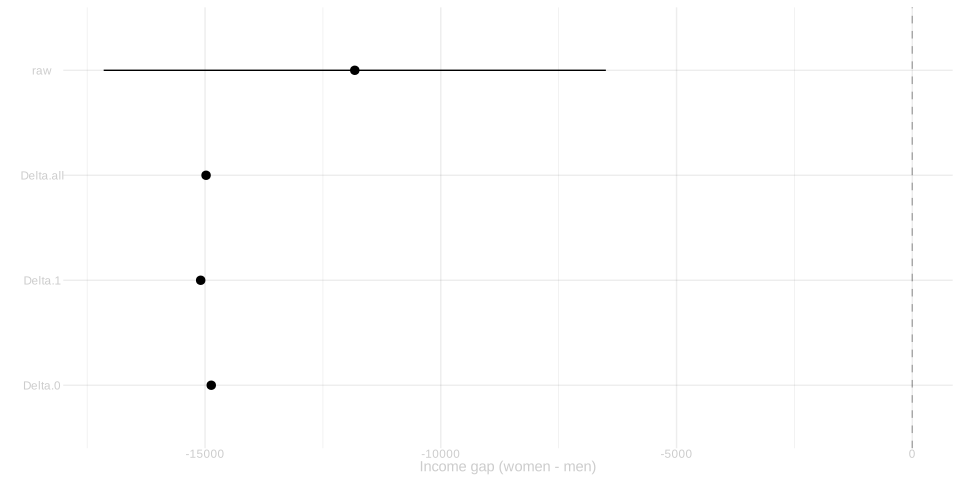
The intervals tell the story:
- \(\hat\Delta_{\text{raw}}\): Women earn about -12k less than men. Relatively precise estimate.
- \(\hat\Delta_1\): Comparing women to similarly-educated men, the gap is -15k. Wider interval.
- \(\hat\Delta_0\): If women had men’s education distribution, the gap would be -15k. Similar precision to \(\hat\Delta_1\).
- \(\hat\Delta_{\text{all}}\): The average within-education gap is -15k.
The Tradeoff
There’s a tradeoff between meaning and precision.
The raw comparison is easy to estimate but hard to interpret—it conflates the effect of sex with differences in education.
The adjusted comparisons are more meaningful but harder to estimate precisely—they require estimating means for subgroups that may be small.
When you report an adjusted comparison, you should report its uncertainty too. A more meaningful but very uncertain estimate may not be more useful than a less meaningful but precise one.
Summary
What We Learned
Adjusted comparisons are unbiased if sample proportions are unbiased for population proportions. They are.
Variance depends on subgroup sizes and weights. An estimator is imprecise when it puts large weight on small subgroups.
Covariate shift hurts precision. When groups have different covariate distributions, adjusted comparisons are harder to estimate.
There’s a tradeoff. More meaningful comparisons (adjusted) are often less precise than simpler ones (raw).
The Formula
For \(\hat\theta = \sum_{w,x} \hat\alpha(w,x) \hat\mu(w,x)\): \[ \mathop{\mathrm{\mathop{\mathrm{V}}}}[\hat\theta] \approx \sum_{w,x} \sigma^2(w,x) \frac{\hat\alpha(w,x)^2}{N_{w,x}} \]
This tells you where the variance is coming from. If one term dominates, that’s the bottleneck for precision.